Why Color Science Matters: The Gap Between the Camera and Your Eyes
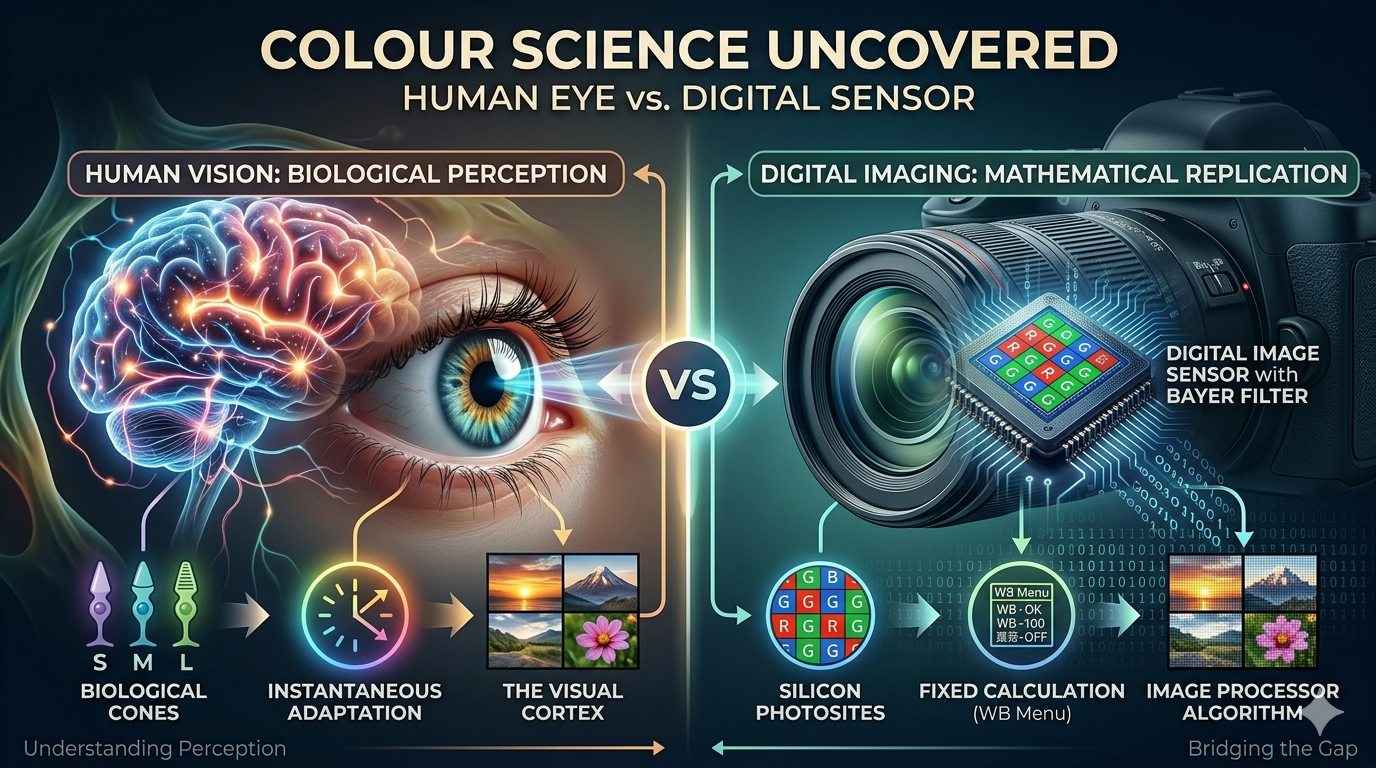
While the human eye pairs with the brain to dynamically adjust white balance and interpret colors contextually, a camera sensor is fundamentally colorblind, relying on literal mathematical filters (like the Bayer filter array) to log raw light data. Color science serves as the "secret sauce"—the proprietary math and profiles used by manufacturers like Canon, Fujifilm, and Sony—to translate that cold binary data into emotionally resonant images that match actual human perception.
Have you ever stood before a breathtaking sunset, snapped a quick photo with your phone or professional camera, and felt an immediate wave of disappointment looking at the screen? The vibrant orange tones look muddy, the deep purples look like washed-out blue, and the actual mood is completely lost.
As someone who has spent years analyzing visual media and working alongside colorists, I can tell you that you aren’t a bad photographer. Instead, you are witnessing a massive technical disconnect between biological vision and digital hardware.
Understanding color science is the key to closing this gap. It isn't just an abstract branch of physics; it is the essential framework that transforms cold digital data into true-to-life visual experiences.
Quick Answer (AEO Snippet): Digital cameras see color differently than humans because camera sensors measure raw light intensity mathematically using a fixed grid of filters, whereas the human eye and brain dynamically interpret light based on context, continuous adaptation, and memory. Color science is the field that translates binary data into images that match human perception.
1. How the Human Eye Sees: The Ultimate Dynamic Processor
Our eyes don’t just record photons; they interpret them in real time. Your retina contains millions of light-sensitive photoreceptors called cones, which are tuned to catch short, medium, and long wavelengths of light—roughly mapping to blue, green, and red.
However, your eyes do not work alone. They are wired straight into your brain, which acts like an ultra-powerful graphics engine.
Chromatic Adaptation: If you step into a room lit by warm, yellow bulbs, your brain instantly adjusts your internal white balance. A white sheet of paper still looks white to you because your brain filters out the yellow cast.
Contextual Evaluation: Human vision sees color relationally. We adjust our perception based on shadows, surrounding textures, and depth, rendering a continuous, emotionally resonant environment.
2. How Digital Sensors See: Absolute Mathematical Literalism
A digital camera has no brain, no memory, and no emotional context. It relies entirely on a flat silicon image sensor covered in millions of microscopic light-collecting cavities called photosites.
Crucially, these photosites are completely colorblind—they only measure the quantity of light hitting them, not the color. To capture a color image, engineers place a mosaic of colored filters over the sensor, most commonly a Bayer filter array.
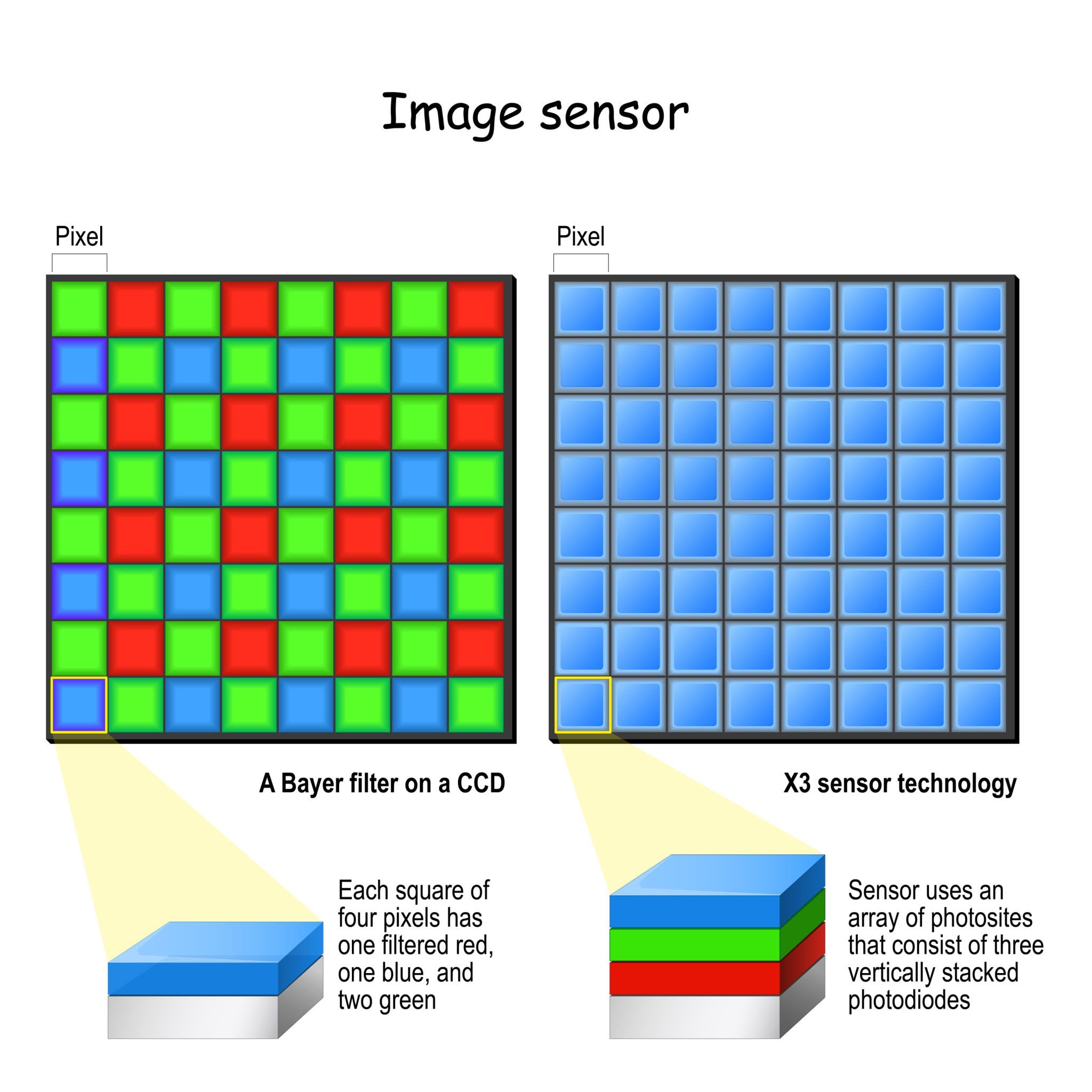
The Bayer Filter: How colorblind sensors separate light wavelengths. Source: ttsz / Getty Images
The Silicon Grid: As shown above, the Bayer filter uses a matrix of two green squares for every one red and one blue square, mimicking our natural sensitivity to green light.
Literal Light Recording: Unlike your brain, a camera is a literal recorder. If you stand under a green fluorescent light, the sensor tracks green photons exactly as they are. It doesn't know that your skin isn't supposed to look sickly; it just logs the raw voltage data.
3. Why Color Science is the Crucial Secret Sauce
Because a sensor records light with raw math while we experience it biologically, a digital image left in its raw state looks flat, low-contrast, and entirely unnatural.
This is where color science steps in. It is the proprietary set of mathematical matrices, lookup tables, and color profiles that guides a camera on how to translate sensor voltage into colors that look correct to human eyes.
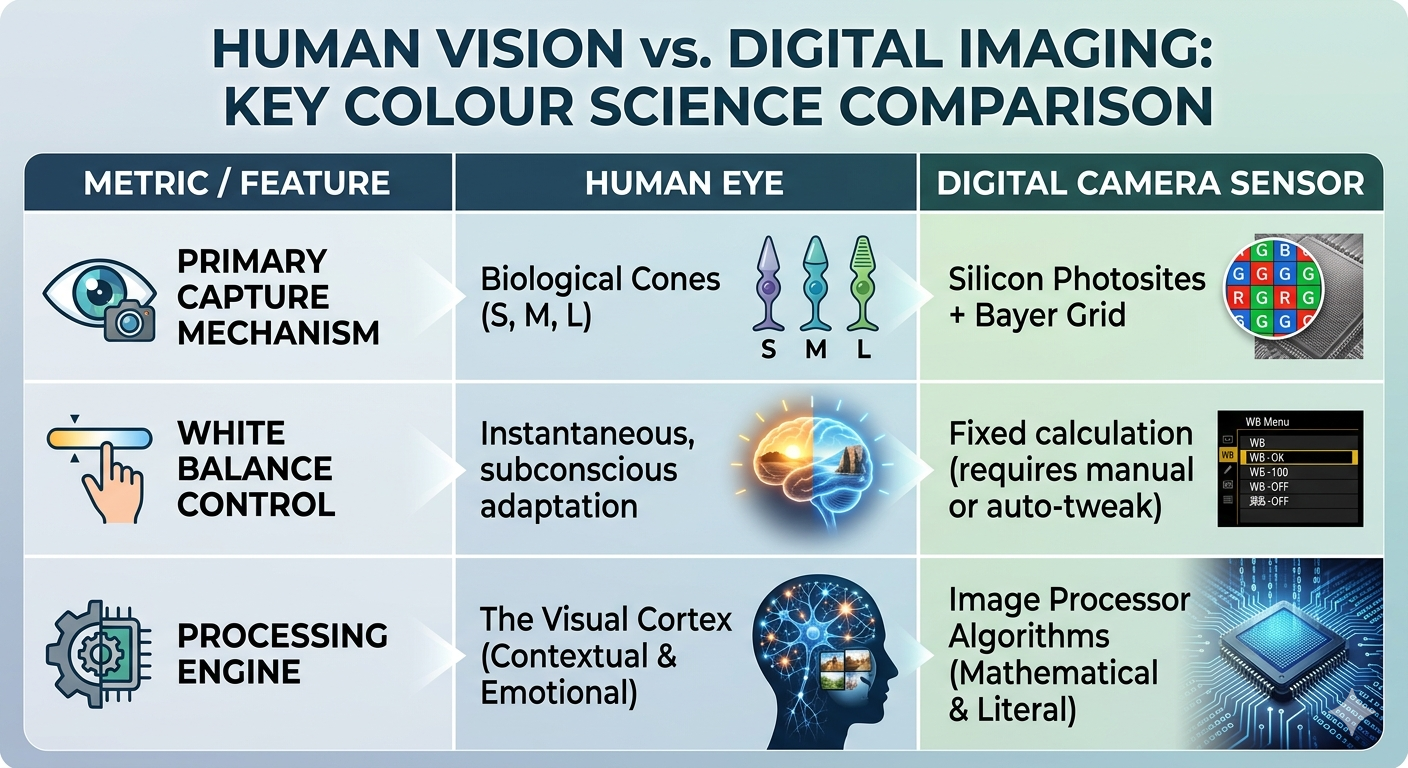
Every major camera manufacturer has its own color science philosophy. It’s why a portrait shot on a Fujifilm camera has a classic, film-like warmth, while a Canon image handles soft skin tones beautifully, and a Sony profile prioritizes clinical accuracy.
Frequently Asked Questions
What exactly does a color scientist do?
A color scientist bridges engineering and art. They design the math models that map raw data from an image sensor into a color space that displays predictably on your monitor or phone screen.
Can a camera ever perfectly replicate human vision?
Not exactly. Because human vision is an interpretive, brain-driven process that changes based on your focus and mood, a camera can only simulate an approximation of what we see. Color science is the art of making that simulation look believable.