Color Grading Academy vs. YouTube Tutorials: Why Structure Beats Scattered Learning
Comparing academy courses vs YouTube tutorials? See why structured curriculum builds real skills faster than scattered free videos. Free YouTube tutorials teach isolated skills, while a structured academy curriculum sequences lessons, practice, and feedback toward a complete competency. For most learners, YouTube works for quick fixes, but an academy's structured path saves time, prevents knowledge gaps, and builds skills that actually transfer to real projects.
If you've typed "how to color grade" into YouTube, you already know the problem: a thousand videos, a thousand opinions, and no clear order to learn them in. A color grading academy vs YouTube tutorials debate usually comes down to one thing structure. YouTube gives you scattered techniques; a structured curriculum builds those techniques into a real, working skill set, in the right order, with feedback along the way. Free tutorials are great for picking up a trick. They're a poor substitute for a curriculum designed to make you employable.
Why This Comparison Matters for Color Grading Students
Color grading isn't one skill - it's a stack of skills: color theory, scopes and technical accuracy, creative look development, client communication, and software fluency, usually in DaVinci Resolve or Baselight. YouTube tutorials teach isolated pieces of that stack, out of order, from creators with wildly different skill levels. A structured academy program teaches the stack in sequence, so each lesson builds on the last instead of sitting in isolation.
This matters most for students who are serious about color grading as a career, not just a hobby. If you're trying to build a portfolio, land your first client, or move from assistant colorist to lead, the gaps left by tutorial-hopping tend to show up exactly when they're most expensive in a client session, on a deadline, in front of a supervisor.
The Core Problem With Learning Color Grading From YouTube
YouTube tutorials are not designed as a curriculum. They're designed to perform well individually, which creates a few recurring problems for students trying to learn the craft properly.
No Sequencing, No Foundation
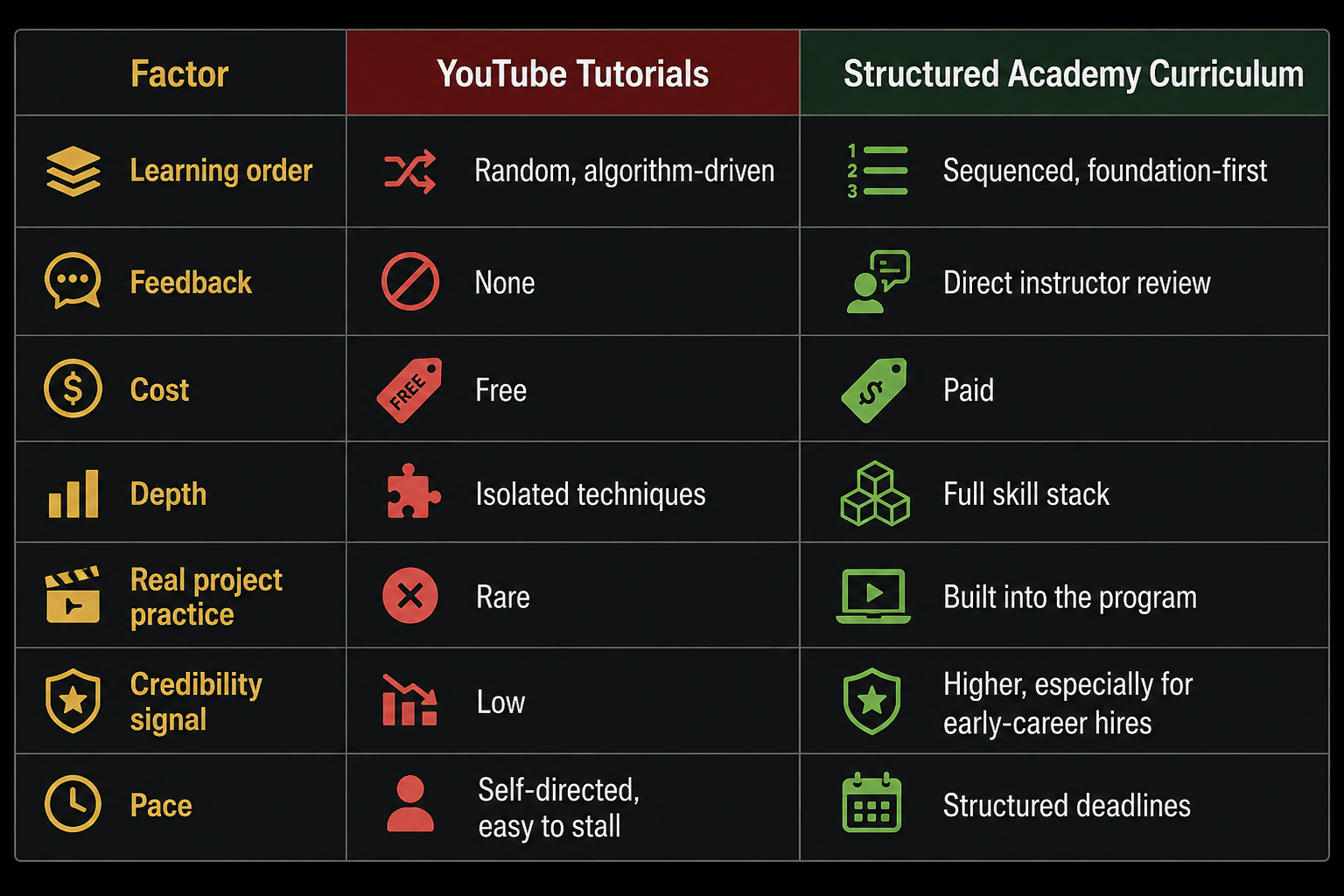
A YouTube algorithm surfaces whatever is trending or clickable, not whatever you actually need to learn next. Students often watch a color grading tutorial from start to finish and try to replicate every single step exactly, without understanding why those choices were made because the video never taught the underlying theory, just the sequence of clicks. You can end up fluent in a dozen unrelated tricks while still lacking the fundamentals vectorscopes, waveform reading, color theory that make those tricks actually useful on a new shot.
Inconsistent Quality and Conflicting Advice
Anyone can publish a color grading tutorial, regardless of their actual experience grading real productions. One video tells you to always grade in a specific color space; the next contradicts it with no explanation of context. Students are left to guess which creator to trust, often without the technical grounding to tell good advice from confident-sounding advice.
No Feedback Loop
A tutorial can show you a technique, but it cannot look at your grade and tell you it's wrong. Color grading is a visual, judgment-heavy craft plenty of technically "correct" grades still look flat, muddy, or inconsistent shot to shot. Without an instructor or mentor reviewing actual work, students can practice the same mistakes for months without knowing it.
Skills Learned Out of Context
Tutorials teach tools in isolation: "how to use qualifiers," "how to build a LUT," "how to match skin tones." Real grading work requires combining all of these under time pressure, on unfamiliar footage, to a client's brief. That integration is exactly what one-off videos can't teach, because it only comes from working through full projects start to finish.
What a Structured Curriculum Actually Provides
A color grading academy isn't just "better tutorials" it's a different learning model entirely, built around progression, feedback, and real project work.
Progressive Skill-Building
A well-designed curriculum sequences lessons deliberately: color theory and perception first, then scopes and technical grading, then creative look development, then delivery and client workflows. Each module assumes mastery of the last, so students build a genuine foundation instead of a pile of disconnected tricks.
Instructor Feedback on Real Work
The single biggest advantage of structured programs is direct feedback. An instructor reviewing a student's grade can catch skin tone issues, inconsistent contrast, or a mismatched look across scenes the kind of mistake a student won't notice on their own because they don't yet have a trained eye for it.
Structured Projects That Mirror Real Work
Instead of grading a single demo clip, curriculum-based programs typically walk students through full projects a short film, a commercial spot, a multi-camera scene that require carrying a consistent look across dozens of shots. That's a much closer simulation of paid work than any single tutorial can offer.
Peer Community and Accountability
Academy programs put students alongside others working toward the same goal, which creates accountability that solo YouTube-watching doesn't.
A Path to Credibility
A completed academy program signals to studios and clients that a student has been trained systematically, not just self-taught from scattered sources. For students trying to break into the industry, that credential combined with a strong portfolio can matter as much as raw skill in getting the first opportunity.
Structured Curriculum vs. YouTube Tutorials at a Glance
When YouTube Tutorials Still Make Sense
None of this makes YouTube useless. Tutorials are genuinely valuable for narrow, specific problems: learning a new software feature, seeing how a specific look was built, or getting a quick refresher on a technique you've already learned properly elsewhere. They're a reference tool, not a replacement for foundational training. Students who complete a structured curriculum often keep using tutorials afterward just to supplement a base they've already built, not to build it.
Choosing the Right Path as a Color Grading Student
If you're grading footage as a casual hobby, YouTube alone may be enough. If you're trying to build a real career freelancing, working in a post house, or eventually leading color on productions a structured curriculum closes the gaps that scattered tutorials leave behind: sequencing, feedback, and real project experience under guidance. [CASE STUDY BLOCK add a brief outcome from a student who moved from self-taught to academy-trained, with a specific result like a job placement or client project]
Frequently Asked Questions
Is it worth paying for a color grading academy if YouTube is free? It depends on your goal. For casual editing, free tutorials can cover what you need. For students pursuing color grading professionally, an academy's structured curriculum, instructor feedback, and real project work build a level of consistency and technical foundation that scattered free videos generally can't replicate on their own.
Can I become a professional colorist using only YouTube tutorials? It's possible but harder, since YouTube lacks sequencing and feedback. Some self-taught colorists do succeed, usually by being unusually disciplined about building their own curriculum and seeking outside feedback. A structured program simply removes the guesswork from that process.
What's the biggest gap in learning color grading from YouTube alone? The lack of feedback. Tutorials can show a technique, but they can't review a student's actual grade and point out what's not working. Without that feedback loop, students can repeat the same mistakes for a long time without realizing it.
How long does a structured color grading curriculum typically take? This varies widely by program, ranging from a few weeks for a focused course to several months for a comprehensive curriculum covering theory, software, and real-project work.